Tuesday, June 20, 2017

Bill Dana

Bill Dana, a comedian and comedy writer whose most famous character, the bumbling, English-mangling José Jiménez, provoked anger as well as laughter, died on Thursday at his home in Nashville. He was 92.

Mr. Dana had been writing for television for several years and performing in nightclubs for nearly a decade when, in 1959, he created José, who appeared for the first time in a sketch on “The Steve Allen Show.” The conceit of the sketch was that José, whose first language was clearly not English, worked as an instructor of department store Santa Clauses. (“Ho ho ho” was written on his blackboard as “Jo jo jo.”) The sketch introduced his signature line, “My name José Jiménez,” which Mr. Dana delivered with such a heavy accent that it came out “ My naing o-ZAY Ee-MAY-nez.”

The character became an immediate hit, and over the next decade Mr. Dana invented a variety of preposterous professions for José, including deep-sea diver, wild animal trainer and, most famously, astronaut. He recorded several hit comedy albums as José (often rendered without accents) and appeared as his alternative self on “The Ed Sullivan Show,” “The Tonight Show,” “The Jackie Gleason Show,” “The Andy Williams Show,” “The Hollywood Palace” and even, in a cameo role, “Batman.” A series of his own, “The Bill Dana Show,” on which he played José as a hotel bellhop, aired on NBC from 1963 to 1965.

Mr. Dana always claimed that José, whose nationality was never specified, was a fond portrait of a decent, striving immigrant, and that the comedy was rooted not in ethnic disparagement but in the difficulty of assimilation.

Saturday, June 10, 2017

Adam West

LOS ANGELES (AP) — Adam West, whose straight-faced portrayal of Batman in a campy 1960s TV series lifted the tight-clad Caped Crusader into the national consciousness, has died at age 88, his publicist Molly Schoneveld said Saturday.

West died Friday night after “a short but brave battle with leukemia,” his family said in a statement.

West played the superhero straight for kids and funny for adults. He initially chaffed at being typecast after “Batman” went off the air after three seasons, but in later years he admitted he was pleased to have had a role in kicking off a big-budget film franchise by showing the character’s wide appeal.

“You get terribly typecast playing a character like that,” he told The Associated Press in a 2014 interview.

“But in the overall, I’m delighted because my character became iconic and has opened a lot of doors in other ways, too.” He returned to the role in an episode of the animated “The Simpsons.”

“He was bright, witty and fun to work with,” Julie Newmar, who played Catwoman to West’s Batman, said in a statement. “I will miss him in the physical world and savor him always in the world of imagination and creativity.”

Burt Ward, who played Batman’s sidekick, Robin, was friends with West for more than 50 years.

“We shared some of the most fun times of our lives together, Ward told the Variety entertainment media outlet. “This is a terribly unexpected loss of my lifelong friend. I will forever miss him.”

A whole new generation of fans knew West as the voice of nutty Mayor Adam West on the long-running animated series “Family Guy.”

“Adam West was a joy to work with, and the kind of guy you always wanted to be around,” ”Family Guy” creator Seth MacFarlane said in a statement.

Friday, May 26, 2017

Roger Moore

Roger Moore, the actor famous for portraying James Bond in seven "007" films between 1973 and 1985, has died after a battle with cancer, according to his family. He was 89.

"We know our own love and admiration will be magnified many times over, across the world, by people who knew him for his films, his television shows and his passionate work for UNICEF which he considered to be his greatest achievement," his children, Deborah, Geoffrey and Christian, said in a statement posted to Moore's official Twitter account on Tuesday.

The family will hold a private funeral in Monaco, per his wishes, the statement said.

Moore is best known as the man who replaced Sean Connery in the James Bond franchise, but his career was much more than playing the debonair spy.

Born in London and the son of a police officer and a housewife, Moore dropped out of high school and went to work as an animation apprentice with a British film company.

His good looks helped get him in front of the camera, however, and he landed a small, uncredited role in the 1945 film "Vacation from Marriage."

That led to a series of uncredited parts before Moore headed to the states in 1953 for a role in Hallmark Hall of Fame's TV production of "Julius Caesar."

He would go on to star as Simon Templar in the popular British television series "The Saint" from 1962 to 1969.

But major success came later in life when at the age of 46 he took on the role of James Bond.

The dapper actor had the longest run as 007. In a 2014, he interview told NPR he thought his version of the spy who never met a foe he couldn't conquer or a woman he couldn't seduce, was the most humorous.

"I look like a comedic lover, and Sean [Connery] in particular, and Daniel Craig now, they are killers," Moore said. "They look like killers. I wouldn't like to meet Daniel Craig on a dark night if I'd said anything bad about him."

Thursday, April 27, 2017

driving: the left lane

Much of the current misunderstanding over the left lane stems from the 55 mph national speed limit that was enacted in 1974, according to the National Motorists Association (NMA), a grassroots drivers’ alliance that lobbies for traffic regulations and safety issues. Before this, passing on the left was an unwritten rule of the road, but after the speed limit was enacted, drivers believed that if they were maintaining the posted speed limit then they could chill anywhere. “Because the speed limit was too low, drivers trying to pass weren’t allowed to and it caused a lot of problems, and it still does,” says Shelia Dunn, Communications Director of the NMA.

Reserving the left lane only for passing other cars—known as “lane courtesy”—reaps surprising benefits, however. Here’s why you should reserve your left-lane use for passing only.

saving gas: the 10 second rule

Follow the 10-second rule.

Whether you’re picking up a slowpoke or waiting at the drive-through, turn off the engine if your wait is longer than 10 seconds. Idling drains your tank by a quarter- to a half-gallon of fuel per hour, whereas restarting only sips 10 seconds worth of gas, according to the U.S. Department of Energy. Even in winter, there’s no need to sit in your driveway “warming up” the engine. Most manufacturers recommend driving off gently after half a minute.

Thursday, April 06, 2017

Don Rickles

LOS ANGELES >> Comedian Don Rickles has died at age 90.

Paul Shefrin, his longtime publicist and friend, said Rickles died today of kidney failure at his Los Angeles home.

For more than half a century, “Mr. Warmth” headlined casinos and nightclubs from Las Vegas to Atlantic City. N.J., and appeared often on late-night TV talk shows.

Rickles, largely known as an insult comic, got his start in comedy performing in nightclubs before making his film debut in the 1958 drama Run Silent Run Deep. He went on to star in several more films, and became a regular on Dean Martin’s Celebrity Roasts.

Monday, March 20, 2017

The Happiest Country

A new report shows Norway is the happiest country on Earth, Americans are getting sadder, and it takes more than just money to be happy.

Norway vaulted to the top slot in the World Happiness Report despite the plummeting price of oil, a key part of its economy. Income in the United States has gone up over the past decade, but happiness is declining.

The United States was 14th in the latest ranking, down from No. 13 last year, and over the years Americans steadily have been rating themselves less happy.

Norway moved from No. 4 to the top spot in the report's rankings, which combine economic, health and polling data compiled by economists that are averaged over three years from 2014 to 2016.

Norway edged past previous champ Denmark, which fell to second. Iceland, Switzerland and Finland round out the top 5.

Sunday, February 12, 2017

Top Ten TED Talks

Garrio Harrison, Digital Strategist
Updated Sep 23, 2012

These are the 10 TED talks I revisit often. I can say without exaggeration each of these positively impacted my outlook both on life and on business.

Thursday, February 09, 2017

a lesson from Quora

I learnt (learned) one common thing about human nature, across nationalities, races, professions, and age groups.

“Give a man a mask and he will show his true face” - Oscar Wilde

Quora has reassured my faith in it. The answers that come from anonymous handles (accounts) are more likely to be relatable and real. People, no matter how honest they are, will play it safe and modify the story a bit (even if a tiny bit) to show them in positive (or less negative) light if their names appear with the answer.

Sumeet Kr Sinha

Sunday, January 29, 2017

showering too much?

What’s your daily routine? Do you wake up, take a shower, brush your teeth, and head out into the world? Or do you prefer a nice relaxing shower before heading off to bed for a good night’s sleep?

Whichever time of day you like to bathe, you probably do so fairly regularly, at least several times a week. After all, cleanliness is key when it comes to being healthy and attractive, right?

Well, maybe not. Maybe, just maybe, you should actually be showering way less than you are.

According to several people, including MIT graduate Dan Whitlock, who invented a line of alternative products designed to replace traditional soaps called MotherDirt, and Atlantic writer James Hamblin, you should maybe stop showering altogether.

Seriously.

Although not ever showering seems too extreme for most people, there is evidence that cleaning yourself too much, especially with soaps and detergents full of drying and artificially-scented materials, can in fact have a detrimental impact on your body, and that people who do not regularly bathe in the manner we do, with hot water and soaps, tend to have healthier and more robust populations of friendly bacteria in and on their bodies, meaning they get fewer infections and have stronger immune systems.

parenting technique

What is the most unique and effective parenting technique you've used or seen used?
Jenni Claire, Have alot of adult offspring
Updated Sat

My older sister has three kids. When my daughter was born, I never wanted to put her down, but I was afraid I'd spoil her. My sister said :

“Just remember, you spoil kids by giving them too much stuff, but you can't spoil them with attention. You can never spoil them by giving them too much affection”.

Best advice anyone ever gave me: Love before stuff.

That's nearly 30 years ago.

Her kids turned out well. Mine have, too. Partly that's just good luck and good circumstances, but partly it was, I think, her excellent technique.

Thursday, January 26, 2017

two things to do everyday

What can I do for 10 minutes every day that will change my life?

Dushka Zapata, Avid learner.
Updated Feb 10, 2016

I love this question and the collection of answers. I will apply many of them to my days ahead. Thank you!

I have two tips I didn't see in a very quick scan of the answers you already have:

Resolve to stop complaining, so that the churning, pointless energy you waste on that is put towards something useful.

Make a daily list of things you are grateful for. Gratitude is powerful. It changes your perspective.

Wednesday, January 25, 2017

Mary Tyler Moore

Mary Tyler Moore, the star of TV’s beloved “The Mary Tyler Moore Show” whose comic realism helped revolutionize the depiction of women on the small screen, died today, said her publicist, Mara Buxbaum. She was 80.

Moore gained fame in the 1960s as the frazzled wife Laura Petrie on “The Dick Van Dyke Show.” In the 1970s, she created one of TV’s first career-woman sitcom heroines in “The Mary Tyler Moore Show.”

“She was an impressive person and a talented person and a beautiful person. A force of nature,” said producer, creator and director Carl Reiner, who created the “The Dick Van Dyke Show,” told The Associated Press. “She’ll last forever, as long as there’s television. Year after year, we’ll see her face in front of us.”

Moore won seven Emmy awards over the years and was nominated for an Oscar for her 1980 portrayal of an affluent mother whose son is accidentally killed in “Ordinary People.”

She had battled diabetes for many years. In 2011, she underwent surgery to remove a benign tumor on the lining of her brain.

Moore’s first major TV role was on the classic sitcom “The Dick Van Dyke Show,” in which she played the young homemaker wife of Van Dyke’s character, comedy writer Rob Petrie, from 1961-66.

With her unerring gift for comedy, Moore seemed perfectly fashioned to the smarter wit of the new, post-Eisenhower age. As Laura, she traded in the housedress of countless sitcom wives for Capri pants that were as fashionable as they were suited to a modern American woman.

Laura was a dream wife and mother, but not perfect. Viewers identified with her flustered moments and her protracted, plaintive cry to her husband: “Ohhhh, Robbbb!”

Moore’s chemistry with Van Dyke was unmistakable. Decades later, he spoke warmly of the chaste but palpable off-screen crush they shared during the show’s run.

They also appeared together in several TV specials over the years and in 2003, co-starred in a PBS production of the play “The Gin Game.”

But it was as Mary Richards, the plucky Minneapolis TV news producer on “The Mary Tyler Moore Show” (1970-77), that Moore truly made her mark.

At a time when women’s liberation was catching on worldwide, her character brought to TV audiences an independent, 1970s career woman. Other than Marlo Thomas’ 1960s sitcom character “That Girl,” who at least had a steady boyfriend, there were few precedents.

Mary Richards was comfortable being single in her 30s, and while she dated, she wasn’t desperate to get married. She sparred affectionately with her gruff boss, Lou Grant, played by Ed Asner, and addressed him always as “Mr. Grant.” And millions agreed with the show’s theme song that she could “turn the world on with her smile.”

The show was filled with laughs. But no episode was more memorable than the bittersweet finale when new management fired the entire WJM News staff — everyone but the preening, clueless anchorman, Ted Baxter. Thus did the series dare to question whether Mary Richards actually did “make it after all.”

The series ran seven seasons and won 29 Emmys, a record that stood for a quarter century until “Frasier” broke it in 2002.

“Everything I did was by the seat of the pants. I reacted to every written situation the way I would have in real life,” Moore told The Associated Press in 1995. “My life is inextricably intertwined with Mary Richards’, and probably always will be.”

Saturday, January 21, 2017

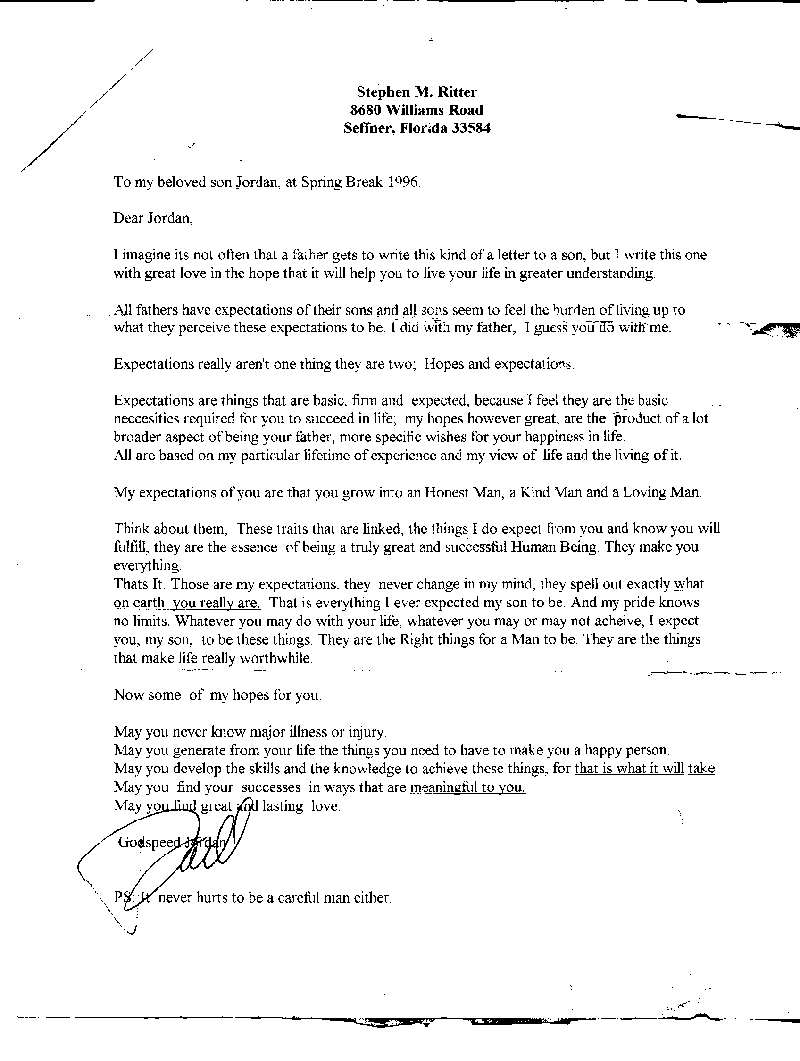
a letter to Jordan Ritter

What are some huge life lessons you've learned that you would want to tell your younger self?

Jordan Ritter, CEO of Atlas Informatics, formerly Napster, Cloudmark

Spend deliberate, intentional time thinking about what you value most, what’s truly important to you. It’s an incredibly hard thing to do, to face your own truth, figure out what things you like, recognize things you don’t like, risk discovering unexpected things about yourself. But, that’s what it is to learn to live with, and ultimately love yourself, and through that, learn truly to appreciate and love other people for who they really are - fantastically diverse, amazing and deeply flawed human beings.

Be a Kind person, be an Honest person, and be a Loving person. For those of you reading this, these are the last words my father wrote to me just before he died when I was 17. He was trying to impart important wisdom on me, which I didn’t get at first, simply because I was too young. Later in life I came to understand how profound the message really was.

The Richard Feynman technique


Denis Matei
Denis Matei, Psychology student,INTJ
Elon uses the “Richard Feynman” technique from what I have read about his approach, mixed with his own technique called “first principles”.
…which is basically in simple terms: don’t try to remember, but try to understand; when you understand, you will remember automatically.
Sounds simple? But yet, so many people don’t do it like that. They try to cram loads of info and facts into their brains, especially students, with the result of forgetting a lot of it.
So how does Elon do it?
‘’One bit of advice: it is important to view knowledge as sort of a semantic tree -- make sure you understand the fundamental principles, ie the trunk and big branches, before you get into the leaves/details or there is nothing for them to hang on to.”
Quote from Elon Musk on Reddit.
So what Elon basically does is, he looks at the most fundamental principle of any subject matter, instead of separating the subject matters into smaller pieces.

signs of intelligence

They ask you questions.
When you answer, they ask you more.
When you start using big words, they ask for clarification.
When they can’t understand anything you’re saying, they ask for you to explain it to them as if they were a five-year-old.
When you say something intriguing, they write it down in their notebook or phone.
These people are not naturally more intelligent. They’re better learners which makes them more intelligent.
Why do they learn better?
They’re genuinely curious and ask questions from a humble standpoint. I’ve met billionaires who’ve said, “explain it to me as if I were a five-year-old.”
This simple phrase has changed my life when it comes to learning.
It comes back to the famous Chinese proverb:
“He who asks a question is a fool for five minutes; he who does not ask a question remains a fool forever”
  • As soon as you stop asking questions, you stop learning.
  • As soon as you stop writing down ideas, you forget them.
The hardest part of becoming intelligent is not bullshitting yourself about what you know; it’s being humble enough to ask questions. If you can do this, then people will see you as intelligent, too.

-- Josh Fechter on Quora

Thursday, January 12, 2017

The Case Against Sugar

Did food companies deliberately set out to manipulate research on American health in their favor? Gary Taubes’s powerful new history, ‘The Case Against Sugar,’ will convince you that they did.

By EUGENIA BONE, Wall Street Journal, Updated Dec. 29, 2016 6:41 p.m. ET

In 2012, New York Mayor Michael Bloomberg announced the Sugary Drinks Portion Cap Rule (aka the Soda Ban) prohibiting the sale of sugary beverages of greater than 16 ounces. His administration had successfully curtailed smoking in restaurants and bars, a move that inspired similar ordinances nationwide, and supporters of the Soda Ban considered the new measure a concrete proposal to respond to the epidemics of obesity and diabetes that have afflicted the country. (Diabetes is the seventh leading cause of death in the U.S.) New York courts tanked the rule, saying that the Board of Health had exceeded its regulatory authority, but not before soda companies had undertaken a counterattack, hiring canvassers to solicit signatures on the street and even launching a perverse television ad campaign claiming that the rule would adversely affect lower-income families.

One wonders whether the debate might have been different if everyone involved had been able to read Gary Taubes’s blitz of a book, “The Case Against Sugar.” In his 2010 best seller, “Why We Get Fat,” Mr. Taubes argued that carbohydrates like grains and starchy vegetables were behind the obesity epidemic. “In a world without cigarettes, lung cancer would be a rare disease, as it once was,” he wrote. “In a world without carbohydrate-rich diets, obesity would be a rare condition as well.” This time around, he focuses on the “unique physiological, metabolic, and endocrinological effects” that sugars have on the human body, how they trigger obesity and diabetes, and the role that the food industry has played in covering up sugar’s contributions to our national health crisis.

Mr. Taubes’s argument is so persuasive that, after reading “The Case Against Sugar,” this functioning chocoholic cut out the Snacking Bark and stopped eating cakes and white bread. It was easier than I expected: Within a week, I was so sensitive to sugar that I could taste it in the weirdest places; in a restaurant salad, for instance, and in my organic yogurt. When I ate a piece of Thanksgiving squash pie, it made my head buzz. I felt like I’d just taken a hit off a tank of nitrous oxide.

For me, getting off sugar was a health tweak, but for many Americans, it may be a matter of life or death. More than 35% of Americans are considered obese, and the health risks of obesity include Type 2 diabetes and heart disease. Almost 50% of Americans have diabetes or pre-diabetes, a condition that features higher than normal sugar levels in the blood—sometimes much higher. Diabetes has long been considered the penalty of obesity, and obesity, reports Mr. Taubes, has long been blamed on a couple of deadly sins—gluttony and sloth—and the consumption of “all calories together, rather than sugar by itself.” The idea that we get obese because we take in more calories than we expend is a notion so ingrained in public-health conversations that “arguments to the contrary have typically been treated as quackery.”

“The Case Against Sugar” builds upon the case he made in “Why We Get Fat,” carefully laying out the science to show that a sugar calorie is not like a spinach calorie but “triggers the progression to obesity, diabetes and the diseases that associate with them.” Here’s how. Sugar is a simple carbohydrate. Carbohydrates in your food are the source of glucose in your blood, and glucose powers your cells. Insulin is a hormone that transports glucose from your bloodstream into your cells and, as Mr. Taubes puts it, “signals the fat cells to take up fat and hold onto it.” Under normal conditions a cell has abundant receptors for insulin and has no problem processing the glucose. But if you consume high, constant volumes of maple syrup, corn syrup, agave, honey, raw or refined sugar, your pancreas responds by producing more insulin, and cells adapt by reducing their responsiveness to it. (The same thing can occur when you eat refined starches like white bread, white rice and potatoes; they are digested so rapidly they flood your bloodstream with glucose.)

What happens next? Basically, the cell stops listening to the insulin knocking at the door. This is insulin resistance. When the cell starts refusing to take glucose from the blood, glucose builds up in the bloodstream, causing the pancreas to make even more insulin, which (you will recall) tells the cells to hold onto your fat. It’s a feedback loop that causes obesity and culminates in Type 2 diabetes. (Type 1 diabetes, which is less common, derives from insulin deficiency.) The link between obesity and Type 2 diabetes is one of such interdependence that the term “diabesity” has been coined.

Methodically, relentlessly, Mr. Taubes argues that “bad science” over the course of many years primarily blamed obesity, diabetes and other “Western diseases” on overeating or lack of exercise or both. This mistake, made by clinicians starting in 1907, became institutionalized because the medical field tends to be obedient to “a small number of influential authorities.” But as the evidence against sugar built, and more researchers reported the correlation between sugar calories, obesity and diabetes, the food industry moved in to protect its turf. Mr. Taubes cites one 1953 ad in which Domino Sugar claimed “3 Teaspoons of Pure Domino Sugar Contain Fewer Calories than One Medium Apple.” That’s a little like saying a cubic meter of methane gas costs less to produce than a cubic meter of sunshine.

“The Case Against Sugar” is a history of the food industry and the medical science that has both supported and denied the role of sugar in disease. It explores the addictive aspect of sugar (which anyone with a toddler is familiar with); the “peculiar evil” of marketing sweets and sweetened cereals to children; and the industry’s 60-year effort to shift the blame for obesity and diabetes to saturated fats and behavior. In the 1960s, for example, the Sugar Association, a trade group, became concerned about the emerging evidence linking sugar to diabetes and heart disease. It worked hard, Mr. Taubes claims, to “combat the accumulating evidence from researchers,” by financing industry-friendly research and besmirching the credibility of scientists whose research suggested that sugar was unhealthy. These efforts were successful enough to influence the language of FDA reports on sugar in 1977 and 1986, as well as the first government-compiled Dietary Guidelines, released in 1980, which unsurprisingly declared that fat caused disease.

Opinions began to change in 2007 when the “Sugar Papers,” a trove of internal documents detailing the relationship between the sugar industry and medical researchers in the 1960s and 1970s, was discovered by Cristin Kearns, the general manager of a large group of dental practices. The trove—which she found by (wait for it . . . ) googling—revealed that the sugar industry had worked with the National Institutes of Health to create a federal program to combat tooth decay in kids that did not recommend limiting sugar consumption. Mr. Taubes convinced me that these food companies deliberately set out to manipulate research on American health to their favor and to the detriment of the American public.

As the author’s own account shows, he is hardly the first to warn of the toxicity of sugar. But busting sugar is tough: In the early ’80s, high-fructose corn syrup replaced sugar in sodas and other products in part because refined sugar had developed a reputation as generally noxious, and corn was a vegetable, for God’s sake. This is a bait and switch. All sugars produce the same biological results if you consume enough. Soda is a particularly pernicious way to overdose on sugar because it’s just sweetened water—drinking a can of Pepsi doesn’t seem analogous to eating cheesecake.

This year, San Francisco became the first American city to require health warnings that say: “Drinking beverages with added sugar(s) contributes to obesity, diabetes, and tooth decay” on public advertisements after the beverage industry failed to get a court order to stop it. Starting on Jan. 1, Philadelphia will be the first major city to institute a 1.5 cent per ounce tax on sodas and other sugary drinks. But the battle goes on. Between 2009 and 2015, soda companies spent $106 million opposing local and federal public-health initiatives, according to Mr. Taubes. Just last year this paper ran an article about the Global Energy Balance Network, a nonprofit funded by Coca-Cola that “suggested Americans were overly fixated on calories and not paying enough attention to exercise.” The story will sound familiar to any reader of Mr. Taubes’s book.

“The Case Against Sugar” should be a powerful weapon against future misinformation. In 2015 the New York Times’s health columnist Jane Brody reported that she’d heard people saying: “Let me know when the nutrition gurus make up their minds and maybe then I’ll change my diet.” Well, there is a lack of agreement about the amount of sugar that can be consumed in a healthy diet. But “ultimately and obviously,” writes Mr. Taubes, “the question of how much is too much becomes a personal decision, just as we all decide as adults what level of alcohol, caffeine, or cigarettes we’ll ingest.” Consider the evidence. Decide for yourself.

—Ms. Bone, the author of “Mycophilia: Revelations from the Weird World of Mushrooms,” is writing a history of microbes.

Sunday, January 08, 2017

two social skills

The most charismatic people have 2 Main things in common. These 2 Traits are learnable, can be brought to a great level without much effort and yet still take time to master fully. Once known they will make you popular, others will listen to you, want to be around you and they will treat you with more respect than they ever have. Here they are:

1. Turn yourself into an active Listener. What is the feeling you get when you talk to someone amazing? Don’t you feel as if the entire world revolves around you for the time you talk to them?
When you can show someone that they are the most important thing to you at this moment in time, they feel amazing. They develop a feeling of gratitude towards you because you treat them like they really matter. In the end, we all want to feel like our life had some meaning, like we weren’t just a grain of sand floating in the wind. Giving someone this feeling is amazing for them, but it also makes you pay attention.

Active Listeners value their conversation partners and everything they have to say, even if they do not agree with it. Most people just listen. They think about other things, get distracted or are not fully attentive to us when we talk. But if you change to become an active listener people will come to you with their problems, they will want to have more conversations with you and they will open up almost naturally to you.

This Skill is difficult to master because it puts a lot responsibility on you, but is quite easy to develop. If you want to make others feel important and meaningful, all you need to do is behave that way. When you are talking to someone important to you, make them feel that way as well. Think that you have to hold a speech on what they say the next day in front of 100 people.

Also, think that whatever they tell you means a lot to them. This is something very personal and close to their heart and they are entrusting you with this right now. Thinking about these two things before going into a conversation will make you pay attention. You will not look at your phone and instead treat them like they mean the world to you right now.

2. Create an amazing attitude. When asked what the goal of life was for people, most responded with “I just want to be happy.” Happiness, feeling elated and excited, are feelings we all seek every day. We spend money on experiences and things that are supposed to make us feel that way. Work hard to be able to pay for a few happy experiences, and even sacrifice most of our life so that we get a small glimpse of it.

Now, what do you believe would happen if you were a source of happiness and excitement for others? How would others behave around you if you made them feel amazing? What about if you had so much fun that they were envious of that fun?

People will start to treat you with more respect. They will value you more because you are giving them that which they seek from life, which means, if you talk to them and are around them, they will listen to you and respect you.

This is a trade you are undergoing here. You are willing to give them the feeling of happiness by sharing your own happiness with them, and for that you receive their attention and respect.


Think about it: Why are people with humor so popular? Comedians and Celebrities with a sense of humor can take over entire stadiums when they speak because they are liked and valued. People listen to them, trust them and aspire to be like them, all because of their positive attitude!

You may not be able to take over entire stadiums when you speak, but maybe your circle of friends and the smaller events you attend. To do this start to have fun for yourself. Be a little selfish and see how you can have the most fun. If you follow that path you will eventually radiate that happiness to the people around you.
Learn to have an amazing attitude and not only will people want to spend more time with you, but you will also have a better life and way more fun!

-- Lukas Schwekendiek via Quora

Sunday, January 01, 2017

the difference between Republicans and Democrats

I recently asked my friend's little girl what she wanted to be when she grew up. She said she wanted to be president of the United States.
Both of her parents, liberal Dems , were standing there, so I asked her what she would do first. She replied: "I'd give food and houses to all the homeless people." Her parents beamed.
“Wow, what a worthy goal,” I told her, “but you don't have to wait until you're president to do that. You can come over to my house, mow the lawn, pull weeds and sweep my driveway, and I will pay you $50. Then I will take you over to the grocery store where the homeless guy hangs out, and you can give him the $50 to use toward a new house and food.”
She thought it over for a few seconds, then asked, "Why doesn't the homeless guy come over to your house and do the work and you can just pay him the $50?"
I said, "Welcome to the Republican Party."

-- Anthony Zarrella via Quora

what liberals and conservatives think of each other

Charles Krauthammer once said this: “To understand the workings of American politics, you have to understand this fundamental law: Conservatives think liberals are stupid. Liberals think conservatives are evil.”

-- Stefan Voiculescu-Holvad on Quora

Tuesday, December 27, 2016

Carrie Fisher and Debbie Reynolds

Carrie Fisher, the actress, author and screenwriter who brought a rare combination of nerve, grit and hopefulness to her most indelible role, as Princess Leia in the “Star Wars” movie franchise, died on Tuesday morning. She was 60.

“Star Wars,” released in 1977, turned her overnight into an international movie star. The film, written and directed by George Lucas, traveled around the world, breaking box-office records. It proved to be the first installment of a blockbuster series whose vivid, even preposterous characters — living “a long time ago in a galaxy far, far away,” as the opening sequence announced — became pop culture legends and the progenitors of a merchandising bonanza.

Ms. Fisher established Princess Leia as a damsel who could very much deal with her own distress, whether facing down the villainy of the dreaded Darth Vader or the romantic interests of the roguish smuggler Han Solo.

Wielding blaster pistols, piloting futuristic vehicles and, to her occasional chagrin, wearing strange hairdos and a revealing metal bikini, she reprised the role in three more films — “The Empire Strikes Back” in 1980, “Return of the Jedi” in 1983 and, 32 years later, “Star Wars: The Force Awakens,” by which time Leia had become a hard-bitten general.

Lucasfilm said on Tuesday that Ms. Fisher had completed her work in an as-yet-untitled eighth episode of the main “Star Wars” saga, which is scheduled to be released in December 2017.

***

[12/28/16] Debbie Reynolds, the Oscar-nominated singer-actress who was the mother of late actress Carrie Fisher, has died at Cedars-Sinai hospital. She was 84.

“She wanted to be with Carrie,” her son Todd Fisher told Variety.

She was taken to the hospital from Todd Fisher’s Beverly Hills house Wednesday after a suspected stroke, the day after her daughter Carrie Fisher died.

The vivacious blonde, who had a close but sometimes tempestuous relationship with her daughter, was one of MGM’s principal stars of the 1950s and ’60s in such films as the 1952 classic “Singin’ in the Rain” and 1964’s “The Unsinkable Molly Brown,” for which she received an Oscar nomination as best actress.

*** [12/30/16]

Carrie Fisher and Debbie Reynolds to be buried together

Monday, December 26, 2016

ways to use flour

I have an old bag of flour that's been sitting in the fridge unopened for probably 10 years (or more).

I'm about to toss it, but maybe I can find some use for it?

Well, how about cleaning my stainless steel sink top?  I think I'll try it before tossing it out.

Tuesday, December 13, 2016

Tom Moffatt

Tom Moffatt — radio disc jockey, concert promoter and one of the most influential figures in the Hawaii entertainment industry — died Monday. He was 85.

Longtime associate Barb Saito, operations manager and vice president of Tom Moffatt Productions, confirmed that Moffatt died Monday night at home after several months of declining health. She described the 35 years she worked with him as “an amazing ride.”

Born Dec. 30, 1930, in Detroit, Moffatt disliked city life and spent most of his teen years working on farms and going to school in small towns outside the Motor City. He came to Hawaii in 1950, enrolled in the University of Hawaii, gravitating toward a career in radio.

Moffatt was playing jazz on KIKI when he started getting requests for a unknown artist named Elvis Presley. With the station’s permission, Moffatt became the first “rock ‘n’ roll” disk jockey in Hawaii and one of the pioneers of modern Top 40 radio.

Moffatt developed the format with Hawaii-born Ron Jacobs at KHVH, KPOA and finally at KPOI — possibly the first time that a station’s call letters formed a pronounceable word. Moffatt, Jacobs and other deejays became the “Poi Boys,” and captivated Hawaii audiences with a seemingly endless series of contests, special events, staged “feuds” between Moffatt and Jacobs, and the “Marathon of Hits” — an annual countdown of the most popular songs in Hawaii as voted on by KPOI listeners. KPOI dominated the Hawaii radio market throughout the 1960s.

Moffatt got involved in concert promotion in the 1950s as an outgrowth of his work in radio. He presented musical revues of the hit artists of the day with the “Show of Stars” concerts and then helped open the Honolulu International Center (now the Neal S. Blaisdell Center) with the first in a series of “Million Dollar Parties.” In the decades that followed Moffatt presented almost every big name in the music business at least once — among his biggest productions were mega-concerts by Michael Jackson, Whitney Houston, Janet Jackson and the Eagles in Aloha Stadium. He also brokered reunion concerts by Cecilio & Kapono, Kalapana and Hui Ohana when conventional wisdom held that the members of the those acts would never work together again.

Moffatt’s involvement in the Hawaii record industry started in the late 1950s. He became a major figure in the Hawaii record industry in the 1970s and 1980s as the head of two labels — Paradise and Bluewater — that released Hoku Hanohano Award-winning recordings by Keola & Kapono Beamer, Andy Bumatai, Loyal Garner, the Aliis, the Kasuals, Rap Reiplinger, The Krush, Hui Ohana and Ledward Kaapana.

Early in his career — while he was still in his 20s, and for reasons now long forgotten — Moffatt’s teenage fans began calling him “Uncle Tom” and dubbed his radio studio as “Uncle Tom’s Cabin.” Moffatt said in 2016 that only one person had ever seemed to take offense at the nickname — an African-American entertainer who arrived from the mainland and wanted to know “Who this ‘Uncle Tom’ guy is.” Prominent kamaaina members of Hawaii’s African-American community have said that although a disc jockey’s use of the name “Uncle Tom” could be problematic elsewhere in the country they found nothing offensive in Moffatt being known as “Uncle Tom” in Hawaii.

Moffatt continued to be active as a concert promoter and radio personality well into his 80s. He returned to radio in the 2000s hosting a Saturday morning program on Kool Gold 107.9 where he entertained listeners with stories about events from the 1950s to present and played songs from the 1950s, 1960s and 1970s — in some cases song that had only been hits in Hawaii.

Moffatt is survived by his wife, Esther “Sweetie” Kealoha Cablay Moffatt, son Troy Moffatt, his brother Norman Moffatt and sister Alice Moffatt.

Monday, December 05, 2016

Van Williams

Van Williams, star of the 1966 TV show “The Green Hornet,” died last Monday. He was 82.

Actress Pat Priest, Williams’ longtime friend and neighbor, confirmed the news to Variety. Priest received an email from Williams’ wife, Vicki Flaxman, about her husband’s death on Sunday.

“Sad news. Van passed away last Monday night,” Flaxman wrote. “He really fought hard, but he had more health issues than he could manage. I am heartbroken.”

Producer Kevin Burns first announced the news on his Facebook page after being forwarded the aforementioned email by Priest.

Williams was a diving instructor in Hawaii when he was discovered in 1957 by producer Mike Todd, who was married to Elizabeth Taylor at the time. Williams was persuaded to come to Hollywood and try his hand at acting, and earned his big break on the ABC private detective show “Bourbon Street Beat.” He played Ken Madison, a character he later recycled for another detective show, “Surfside 6.”

In 1966, Williams signed a deal with 20th Century Fox to star in “The Green Hornet” as both the titular masked crusader and his newspaper editor alter ego, Britt Reid. He was ably supported by his martial arts master sidekick Kato, played by Bruce Lee, and by his weaponized car, Black Beauty. Williams played the role straight, signaling a departure from the lampoon comedy of Fox’s earlier “Batman” series.

Williams later appeared in iconic shows such as “The Beverly Hillbillies” and “The Dick Van Dyke Show,” as well as in the young adult-targeted “Westwind,” which centered around the adventures of the Andrews family who sailed around the world on a yacht.

After his acting career dropped off in the late 1970s, Williams became a reserve deputy sheriff and a fire fighter in the Los Angeles area.

Saturday, December 03, 2016

Grant Tinker

Grant Tinker, a television producer and network executive who ushered in a new era of sophisticated prime-time programming in the 1970s and 1980s, championing such well-received series as “The Mary Tyler Moore Show,” “Hill Street Blues,” “Cheers” and “The Cosby Show,” and who turned around NBC’s flagging fortunes in the early 1980s, died Nov. 28 at his home in Los Angeles. He was 90.

NBC announced his death. The cause was not disclosed.

Mr. Tinker, who began his career at NBC during the dawn of the television era, later became an advertising executive who helped develop “The Dick Van Dyke Show” in the early 1960s. Several years after he married the sitcom’s co-star, Mary Tyler Moore, the two founded a production company, MTM Enterprises, that launched some of television’s most honored and successful programs.

Their first effort, “The Mary Tyler Moore Show,” debuted on CBS in 1970 and featured the personal and professional misadventures of a single woman working in a TV newsroom. The groundbreaking series, which brought the concerns of working women to prime-time television, went on to win 29 Emmy Awards during its seven seasons.

Three of the show’s spinoffs, “Rhoda,” “Lou Grant” and “Phyllis,” became critical and commercial hits, along with other MTM sitcoms such as “The Bob Newhart Show,” about a Chicago psychologist, and “WKRP in Cincinnati,” about the staff of a Top-40 radio station.

After his success at MTM, Mr. Tinker was named chairman of NBC in 1981. NBC was in last place among the three major broadcast networks of the time and was in such bad shape that its parent company, RCA, was thinking of selling it or shuttering it altogether.

Mr. Tinker took a patient approach, renewing shows that didn’t immediately find an audience, such as Bochco’s gritty police drama “Hill Street Blues” and the hospital show “St. Elsewhere” — both produced by MTM. Despite dismal early ratings, he renewed “Cheers,” a comedy set in a Boston neighborhood bar, and “Family Ties,” about aging hippies raising children in the 1980s. All became long-running hits.

He revamped NBC’s news operation and added prime-time blockbusters to the lineup, such as “L.A. Law,” the stylish detective series “Miami Vice” and, especially, “The Cosby Show.” The Cosby sitcom was the breakout No. 1 hit and established the network’s “must-see TV” comedy block on Thursdays for decades to come.

By the end of 1985, Mr. Tinker had transformed NBC from an industry laughingstock to TV’s most-watched network. Johnny Carson and David Letterman ruled late-night television, and “Today” had become the No. 1 morning show.

Friday, November 25, 2016

take a deep breath

Take a deep breath, expanding your belly. Pause. Exhale slowly to the count of five. Repeat four times.

Congratulations. You’ve just calmed your nervous system.

Controlled breathing, like what you just practiced, has been shown to reduce stress, increase alertness and boost your immune system. For centuries yogis have used breath control, or pranayama, to promote concentration and improve vitality. Buddha advocated breath-meditation as a way to reach enlightenment.

Science is just beginning to provide evidence that the benefits of this ancient practice are real. Studies have found, for example, that breathing practices can help reduce symptoms associated with anxiety, insomnia, post-traumatic stress disorder, depression and attention deficit disorder.

Florence Henderson

LOS ANGELES » Florence Henderson, who went from Broadway star to become one of America’s most beloved television moms in “The Brady Bunch,” has died. She was 82.

Henderson died at Cedars-Sinai Medical Center in Los Angeles on Thursday night, a day after she was hospitalized, said her publicist, David Brokaw. Henderson had suffered heart failure, her manager Kayla Pressman said in a statement.

Family and friends had surrounded Henderson’s hospital bedside, Pressman said.

On the surface, “The Brady Bunch” with Henderson as its ever-cheerful matriarch Carol Brady resembled just another TV sitcom about a family living in suburban America and getting into a different wacky situation each week.

But well after it ended its initial run in 1974, the show resonated with audiences, and it returned to television in various forms again and again, including “The Brady Bunch Hour” in 1977, “The Brady Brides” in 1981 and “The Bradys” in 1990. It was also seen endlessly in reruns.

“It represents what people always wanted: a loving family. It’s such a gentle, innocent, sweet show, and I guess it proved there’s always an audience for that,” Henderson said in 1999.

Premiering in 1969, it also was among the first shows to introduce to television the blended family. As its theme song reminded viewers each week, Henderson’s Carol was a single mother raising three daughters when she met her TV husband, Robert Reed’s Mike Brady, a single father who was raising three boys.

The eight of them became “The Brady Bunch,” with a quirky housekeeper, played by Ann B. Davis, thrown into the mix.

Maureen McCormick, who played the eldest Brady daughter, Marcia, tweeted, “You are in my heart forever Florence.” ”Dancing With the Stars” host Tom Bergeron tweeted, “Heartbroken. I’ll miss you, my friend.” Henderson’s last public appearance was Monday at the “Dancing With The Stars” taping where she was in the audience to support McCormick, who competed this season.

Saturday, October 22, 2016

Wonder Woman: United Nations ambassador

[10/22/16] Not one but two Wonder Women assembled at the United Nations on Friday, as the iconic superhero was named an honorary ambassador for the empowerment of women and girls.

Gal Gadot and Lynda Carter joined Wonder Woman director Patty Jenkins and DC Entertainment president Diane Nelson at the U.N. for a special ceremony recognizing the 75-year-old superhero. As part of the U.N.’s sustainable development goal number five, which focuses on promoting gender equality, the U.N., DC, and Warner Bros. plan to use Wonder Woman’s image to raise awareness for gender-based issues around the world.

The U.N. ceremony marked the first joint public appearance of Gadot, who appeared in Batman v Superman: Dawn of Justice and will star in next year’s Wonder Woman, and Carter, who starred in the long-running ‘70s TV show. Both women spoke at the ceremony about the longevity and cultural impact of Wonder Woman, who celebrates her 75th anniversary this year.

[12/13/16] The United Nations has ended its campaign with Wonder Woman to promote gender equality after less than two months, DC Entertainment told NBC News on Monday — bringing to a close a venture that was loudly protested from the beginning.


Monday, September 12, 2016

why are our presidents so bad?

Brad Porter on Quora:

I am going to be profoundly contrarian here. It is very, very easy to say “aww hell all politicians are crooks!” or “dammit I hate this candidate, but I hate their opponent more!” or “politics is dirty!” or “the system is rigged!” or whatever else. Cynicism is cheap. We spend much of our time focused, laser-like, on the flaws and controversies of everyone who enters the public sphere. It’s natural, and it’s even constructive.

So allow me a counterpoint.

You can say what you want about any one of these men - notice I will not say a word on the politics of any of them nor will I even discuss their time as president - but let me at least lay it out for you.

Our current president is one of the most gifted orators of the last half century, with a profoundly inspiring background whose very existence as a public figure gives hope to millions. He is an extremely intelligent and profoundly decent man, who rocketed to political success after a background in community organizing, law, and academia and on the basis of an expressed vision that what unites us is stronger than what divides us.

This man [George W. Bush] was the extremely popular two-term governor of one of the nation’s most populous states - when he was reelected in 1998 it was with the highest vote total of any governor in Texas history. He had a knack with connecting with people in a way that many politicians didn’t - he never, in the Southern way of speaking, “put on airs.” Being the son of a President and the brother of a very popular governor of another populous state, he came from a pedigree few could match. When he won in 2000, it was against a primary field that was one of the most impressive ever. And he won in large measure because he espoused a vision of the GOP that was compassionate and big tent.

This man [Bill Clinton] could make a reasonable claim to being among the most intelligent individuals of the late 20th century. A Rhodes Scholar, Oxford educated, tremendously bright lawyer, he chose to enter public service, beginning as Attorney General and then as Governor of Arkansas - he was 32 when he was first elected Governor, the youngest in the country by far and among the youngest to ever hold the office of Governor of any state. When he was elected again in 1982 he then served in the office for ten years straight before bursting onto the national scene.

Arguably one of the most accomplished Americans of his generation - and it was a doozy - this man [George H.W. Bush] joined the Navy on his 18th birthday, following Pearl Harbor, became an aviator (quite literally the youngest aviator in the entire United States Navy at the time), left the service at the end of the war, breezed through Yale in two and a half years, founded an oil company, and was a millionaire by the age of 40. He chose to become a public servant then, was elected to the United States House of Representatives, became the United States Ambassador to the United Nations, then a special envoy to China at a critical time, then became the director of the CIA. Following that he became a two-term Vice President, before being elected President himself.

Raised poor, this man [Ronald Reagan] started out as a radio announcer, then as an actor. While his acting career was not that noteworthy, he was held in such high esteem by his peers that he was chosen to lead the Screen Actors Guild as president, twice elected during the 50s when that was arguably one of the most important unions in America. Like Obama, his “coming out” was as a convention speaker, where he showed an uncanny vision for an optimistic Republicanism. He was then elected Governor of the most populous state in the union, and won reelection easily. He ran unsuccessfully for president twice, gaining tremendous respect and national exposure in the process, before finally winning the nomination and then the office. He was subsequently reelected by the largest electoral college margin in American history.

[and so on..]


Beyond that, I think there is something we don’t often realize.

Public service is a very crappy way to become rich or famous.

It’s true! If you are an extremely smart individual, and your goal is fortune - you do not give up your career on Wall Street or in Silicon Valley to go run for the open seat in AZ-2. Typically, the people who get elected to state office are people who have been paying their dues for years, organizing voters, signing people up with clipboards, schmoozing donors, and on and on. You wind up spending all of your 20s and most of your 30s doing mundane work for no pay. Your peers, typically, are busy making partner or getting VC funding while you’re worrying about yard signs. It is a lousy way to get rich.

If you are an extremely vain individual, and your goal is popularity or power - public service is likewise an awful avenue. You spend most of your life in public service eating shit. You have to sit there and listen to constituents tell you every crazy reason in the book why you’re a Jew Illuminati and you just smile and nod. Before you even sniff ballot access as a major party candidate, you have to pay your dues shadowing small-ball idiots who nevertheless you have to treat as the next JFK. And, most people who run for office….well, lose. They don’t tell you that part. Hell, even in my little above exercise, nearly all of those guys got stomped at one point of another. And most people don’t even get that far - they die on the vine trying to build name ID for a local congressional race in New Hampshire. It is a lousy way to get famous.

And this is all way before we’re talking a presidential run.

The truth is: a person who has dedicated their life to public service, has typically done so because they believe in something.

And, more to the point, the very fact that they are running for office usually means they are sacrificing something to try to make a difference. That they have paid dues, come through the ranks, offered something of themselves.

It’s not for everyone! There are smarter people around - Elon Musk, I’m sure, has maybe better ideas…but would he make a better public servant? I don’t know. I actually doubt it.

Sunday, September 11, 2016

Uhura

The world that Roddenberry put together 50 years ago was different than anything that had been on TV as far as the cast was concerned. Crew members represented a variety of races and gave women jobs of respect.

Most of that came through the casting of Nichelle Nichols as Uhura, the ship’s communications officer. Black actresses at that time on TV were cast as servants or second-class citizens. That fact was not lost on viewers, one fan in particular.

Although Nichols was given a prominent role on the ship, her work load was so limited she decided to leave. The day after she told Roddenberry she planned to beam off the show, she was at an NAACP fundraiser and was told there was a big fan who wanted to meet her.

“I thought it was a Trekkie, and so I said, ‘Sure.’ And I stood up, and I looked across the room, and there was Dr. Martin Luther King walking towards me with this big grin on his face,” Nichols says. “He reached out to me and said, ‘Yes, Ms. Nichols, I am your greatest fan.’ He said that ‘Star Trek’ was the only show that he and his wife, Coretta, would allow their three little children to stay up and watch.”

She told King about her plans to leave the series.

“I never got to tell him why, because he said, ‘You can’t,’ “ Nichols says. “He said, ‘You’re part of history, and this is your responsibility even though it might not have been your career choice.’ “

He said it was her duty to stay on the show and be a positive role model.

Nichols went back to work and told Roddenberry she would stay. When Roddenberry heard what King had said, he cried.

Read more here

Monday, August 29, 2016

Go Ask Alice

Alice Inoue, I suppose, is the spiritual successor to Ruth Wong writing about self-improvement, organization, clearing clutter, etc.

Her article yesterday caught my eye.  Ironically when I searched for it, it turned out to be a reprint of an article from 2014!

Alice's column is in the Hawaii Renovation section of the Sunday paper.  I don't see it pop up in a search of the regular archives, but it is available online and as a digital issue (for example, here), but the digital issues are hard to navigate and read on my old compter.

An archive of Alice's articles is available here.  Having an archive of Alice's articles is somewhat ironic too :)

***

10/15/17 - Alice on Marie Kondo

Sunday, August 28, 2016

to floss or not to floss?

The federal government has recommended flossing since 1979, first in a surgeon general's report and later in the Dietary Guidelines for Americans issued every five years. The guidelines must be based on scientific evidence, under the law.

Last year, the Associated Press asked the departments of Health and Human Services and Agriculture for their evidence, and followed up with written requests under the Freedom of Information Act.

When the federal government issued its latest dietary guidelines this year, the flossing recommendation had been removed, without notice. In a letter to the AP, the government acknowledged the effectiveness of flossing had never been researched, as required.

The two leading professional groups — the American Dental Association and the American Academy of Periodontology, for specialists in gum disease and implants — cited other studies as proof of their claims that flossing prevents buildup of gunk known as plaque, early gum inflammation called gingivitis, and tooth decay.

However, most of these studies used outdated methods or tested few people. Some lasted only two weeks, far too brief for a cavity or dental disease to develop. One tested 25 people after only a single use of floss. Such research, like the reviewed studies, focused on warning signs like bleeding and inflammation, barely dealing with gum disease or cavities.

When the ADA was asked for proof of its claim that flossing helps prevent early gum disease and cavities, the group cited the 2011 review and a 2008 two-week study that measured bacteria and did not even consider gum disease.

In a later statement to the AP, the ADA said flossing "removes plaque" and "is proven to help remove" debris from between teeth. A video on its website proclaims that flossing "helps prevent gum disease." When pressed, Matthew J. Messina, a practicing dentist and spokesman for the dental association, acknowledged weak evidence, but he blamed research participants who didn't floss correctly.

National Institutes of Health dentist Tim Iafolla acknowledged that if the highest standards of science were applied in keeping with the flossing reviews of the past decade, "then it would be appropriate to drop the floss guidelines."

Regardless, he added, Americans should still floss.

"It's low risk, low cost," he said. "We know there's a possibility that it works, so we feel comfortable telling people to go ahead and do it."

Sunday, July 17, 2016

Sgt. Sacto

Captain Honolulu” was KHVH’s (now KITV) answer to the successful “Checkers and Pogo” kids’ afternoon show on KGMB. John Farrington was hired to play the lead.

“Unfortunately, the night before, Farrington partied too hard and didn’t show up for the live show. We panicked,” Grimm recalls. “The program director, Bob Smith, said he had an Air Force flight jacket and cap, and we sent him home to get it.

“We decided he would be Sgt. Sacto and substitute for Captain Honolulu, who was chasing criminals on Mars. The name Sacto may have come from the acronym of SAC – the Strategic Air Command.

“Farrington was fired and never appeared as ‘Captain Honolulu,’ leaving sidekick Sgt. Sacto to host the show. It ran for years.”

The show aired in the 1960s when television was black and white. Sgt. Sacto chatted with kids between cartoons (such as “Popeye,” “Mickey Mouse” and “Bugs Bunny”).

“Sacto was famous for creating a mask with his thumb and fingers, turned inside out in a way that few could mimic. Kids at every elementary school tried, and those that could earned a special status.”

Tuesday, June 28, 2016

Lady Gaga: hostile foreign force

Lady Gaga has reportedly been added to a list of hostile foreign forces banned by China’s Communist party after she met with the Dalai Lama to discuss yoga.

The American pop singer, who has sold more than 27m albums, met the exiled Tibetan spiritual leader on Sunday before a conference in Indianapolis.

A video of the 19-minute encounter – in which the pair pondered issues such as meditation, mental health and how to detoxify humanity – was posted on the singer’s Facebook account.

The meeting sparked an angry reaction from Beijing, which has attacked the spiritual leader as a “wolf in monk’s robes”.

The Dalai Lama, who fled into exile in March 1959, insists he is merely seeking greater autonomy from Chinese rule for Tibetans.

But China’s rulers consider him a separatist who they claim is conspiring to split the Himalayan region from China in order to establish theocratic rule there.

Following Lady Gaga’s meeting, the Communist party’s mysterious propaganda department issued “an important instruction” banning her entire repertoire from mainland China, Hong Kong’s pro-democracy newspaper Apple Daily reported on Monday.

Chinese websites and media organisations were ordered to stop uploading or distributing her songs in a sign of Beijing’s irritation, the newspaper said.

Saturday, May 21, 2016

Wilbur Post

Alan Young, a comedian and veteran supporting actor who found wide fame as an unlikely sort of second fiddle — the hapless straight man to a talking horse in the 1960s sitcom “Mister Ed” — died on Thursday in Woodland Hills, Calif. He was 96.

Mr. Young had been a popular radio and television personality and had appeared in several films, including “Tom Thumb” (1958) and “The Time Machine” (1960), when, in his early 40s, he landed the role of Wilbur Post, the bumbling, well-meaning architect who owned a loquacious, fun-loving horse named Mr. Ed.

“Mister Ed” became a hit, running from 1961 to 1966 on CBS. The episodes usually revolved around Wilbur’s clumsy attempts to undo Ed’s mischief, situations made more difficult by the fact that Ed would speak only to Wilbur.

Mr. Young had a mischievous streak himself: Many years after the fact, he said he had started the rumor that the crew got Ed to “talk” by coating his mouth with peanut butter. Actually, the crew would place a piece of nylon in Ed’s mouth; the horse would then try to remove it by moving his lips, giving the illusion that he was talking when the voice of Allan Lane, a star of B westerns, was added. (Mr. Lane died in 1973).

In 1950 he brought “The Alan Young Show” to TV. It remained on the air until 1953. In 1951 it won the Emmy Award for best variety show, and Mr. Young won for best actor. (Sketch actors were included in that category at the time.)

Throughout the ’50s he appeared in numerous TV roles and on the variety shows of Steve Allen, Ed Sullivan, Dinah Shore and others. In later decades he made guest appearances on dozens of series, including “Death Valley Days,” “The Love Boat,” “Coach” and “ER.”

His last film was “Em & Me” (2004), an independent feature in which he played an elderly man traveling cross-country to visit his ex-wife’s grave.

Mr. Young was also a frequently heard voice in animated movies like “The Great Mouse Detective” and television cartoon series like “The Ren & Stimpy Show” and “The Smurfs.” He was the voice of Scrooge McDuck in several Disney projects.

He published two autobiographies: “Mister Ed and Me” (with Bill Burt) in 1995 and “There’s No Business Like Show Business ... Was” (2006), an account of his career and life in Hollywood.

Planning for long-term care

As part of retirement planning for my clients, I always ask them the question, “Have you planned for long-term care?” Very often the answer is no. I proceed to ask, “Why not?” The answers I often get are: “Don’t Medicare and Medicaid cover that?” “I told my wife to just let me make (pronounced mah-kay, Hawaiian for ‘die’) if I ever get into that situation” or “My children will take care of me.”

People who do answer “Yes, we have thought about long-term care” are almost always those people who have experienced it firsthand through their family members. They understand the financial and emotional burden that long-term care can cause for families.

So, what is long-term care? Long-term care is when people require assistance, both medical and nonmedical, because they cannot care for themselves. According to the U.S. Department of Health and Human Services, 70 percent of those age 65 and over will require long-term care in their lifetime, and for married couples there is a 91 percent chance that one spouse will need long-term care at some point. Furthermore, the average amount of time that people stay in long-term care is three years.

Long-term care is the biggest threat to your retirement nest egg because of how expensive it is to get care, especially here in Hawaii. According to Genworth Cost of Care Survey 2015, Hawaii’s average annual cost of adult day care was $19,000 and a whopping $135,000 for a stay in a nursing home. Not many retirees have enough income to cover that kind of expense, yet many people overlook this in their retirement planning. Also, relying on your children can create a huge burden as they might already have their plates full with careers and raising their own children. We refer to them as the sandwich generation.

Now let me clear up some misconceptions that people often have when it comes to paying for long-term care:

1. “Medicare will pay for my care.”

Medicare will not cover most long-term care expenses because the majority of these services are considered “custodial care.” Custodial care is nonmedical assistance for daily living activities such as bathing, eating, dressing and using the toilet. And even if you require medical care, there are stringent requirements that you must meet to get Medicare coverage. For example, you must be hospitalized for a minimum of three days, then transferred to a long-term care hospital within 60 days of discharge. Even if you meet these requirements, Medicare will cover only up to 100 days of care. It covers 100 percent of the first 20 days, then after that, you are responsible for a copayment of $157.50 per day. After the 100 days you are responsible for the entire bill on your own.

2. “Medicaid will pay for my care.”

Unlike Medicare, Medicaid does cover long-term custodial care services. However, Medicaid is a joint federal and state program meant for low-income individuals. Medicaid applicants in Hawaii are disqualified if they have assets of $2,000 or more. You can’t transfer your assets to family members to try to qualify for Medicaid, as they will look back five years before the date you apply for Medicaid. When I found out that over half of all long-term care in the U.S. is paid by Medicaid, I was in disbelief. I thought to myself, “How can that many people have less than $2,000 in assets?” Then I realized they weren’t always broke; the long-term care bills made them broke. Those who don’t have long-term care insurance will begin by paying out of pocket. Then they will quickly run out of savings and eventually rely on Medicaid. That thought made me sad. These people who had worked hard to buy their home and build their life savings now have nothing. They are forced to spend the last years of their lives relying on government assistance. I wouldn’t want to end my life this way, nor do I want to see my parents in this type of dire situation.

How can we plan for long-term care so that we don’t have to become completely broke and rely on the government or our families to take care of us? There are several options.

Long-term care insurance: Long-term care insurance will have either daily or monthly coverage plans, with periods ranging from one year to lifetime coverage. Many of them also offer inflation protection so the benefits will continue to increase every year to keep up with the rising cost of care. One thing consumers need to be aware of with long-term care insurance is that insurance companies can raise the premiums on existing policyholders. Many policyholders were hit with huge increases (some up to 90 percent) in their premiums in the last five years. Insurance companies says it’s due to the lower-than-expected numbers of policies being canceled and a higher-than-expected number of people filing for claims. When insurance companies raise premiums, most of them will give the policyholder an option to either keep the same coverage and pay the higher premium, or lower the coverage in order to keep paying the same premium.

Life insurance with long-term care benefit: This type of insurance is becoming more popular. It is life insurance and long-term care insurance all in one. Some companies will even offer a spousal coverage, in which both spouses can be covered under one policy. The obvious benefit of life plus long-term care insurance is that if you and your spouse die without using the long-term care benefit, your beneficiary will receive the death benefit. However, according to the statistics, if you get a policy with your spouse, there is a 91 percent chance one of you will use it.

Self-insure, or saving money for potential long-term care needs: If this is the option you are choosing, you should save for at least three years of care. If you are married, multiple that by 2. Let’s do the math: $135,000 x 3 years x 2 people = $810,000. Let’s now add 2 percent inflation to that number. Say you’re 65 years old and you’re going to need care in 20 years. It’s going to cost you and your spouse more than $1.2 million — money you need to save in addition to your retirement. The majority of people are struggling to save enough for retirement income, so saving another $1.2 million is a stretch.

Whatever option you choose to protect yourself from the expense of long-term care, it’s important you have this conversation with your family so you have a plan for it. We have an aversion to discussing mortality, but it’s so important to have this discussion to avoid any disagreements among kids, or having to race the clock to establish a plan. Have it in place while you’re still sharp and healthy. The irony I see too often is when people are healthy, they don’t want to talk about it. When they become ill and realize they need a plan, it’s too late to get any sort of protection. With anything in life, proper planning will help you avoid a lot of stress and problems down the road. So talk to your family and your financial adviser today to make sure you (and your parents) have a solid long-term care plan in place. It gives you great peace of mind knowing exactly how you will be taken care of and how that care will be paid for.

Kana Aikawa is a financial adviser at Wealth Managing Partners, Inc. She has a Bachelor of Business Administration in Finance and Management from the Shidler College of Business at the University of Hawaii at Manoa. Reach her at 954-7072.

Monday, May 16, 2016

The Dalai Lama's map of the mind

ROCHESTER, Minn. — The Dalai Lama, who tirelessly preaches inner peace while chiding people for their selfish, materialistic ways, has commissioned scientists for a lofty mission: to help turn secular audiences into more self-aware, compassionate humans.

That is, of course, no easy task. So the Dalai Lama ordered up something with a grand name to go with his grand ambitions: a comprehensive Atlas of Emotions to help the more than seven billion people on the planet navigate the morass of their feelings to attain peace and happiness.

“It is my duty to publish such work,” the Dalai Lama said.

To create this “map of the mind,” as he called it, the Dalai Lama reached out to a source Hollywood had used to plumb the workings of the human psyche.

Specifically, he commissioned his good friend Paul Ekman — a psychologist who helped advise the creators of Pixar’s “Inside Out,” an animated film set inside a girl’s head — to map out the range of human sentiments. Dr. Ekman later distilled them into the five basic emotions depicted in the movie, from anger to enjoyment.

Dr. Ekman’s daughter, Eve, a post-doctoral fellow in integrative medicine research, worked on the project as well, with the goal of producing a guide to human emotions that anyone with an Internet connection could study in a quest for self-understanding, calm and constructive action.

“We have, by nature or biologically, this destructive emotion, also constructive emotion,” the Dalai Lama said. “This innerness, people should pay more attention to, from kindergarten level up to university level. This is not just for knowledge, but in order to create a happy human being. Happy family, happy community and, finally, happy humanity.”